
A plain-language guide to spore trap sampling, the most common mold air test in Florida homes. Learn how the cassette, pump and lab analysis fit together.
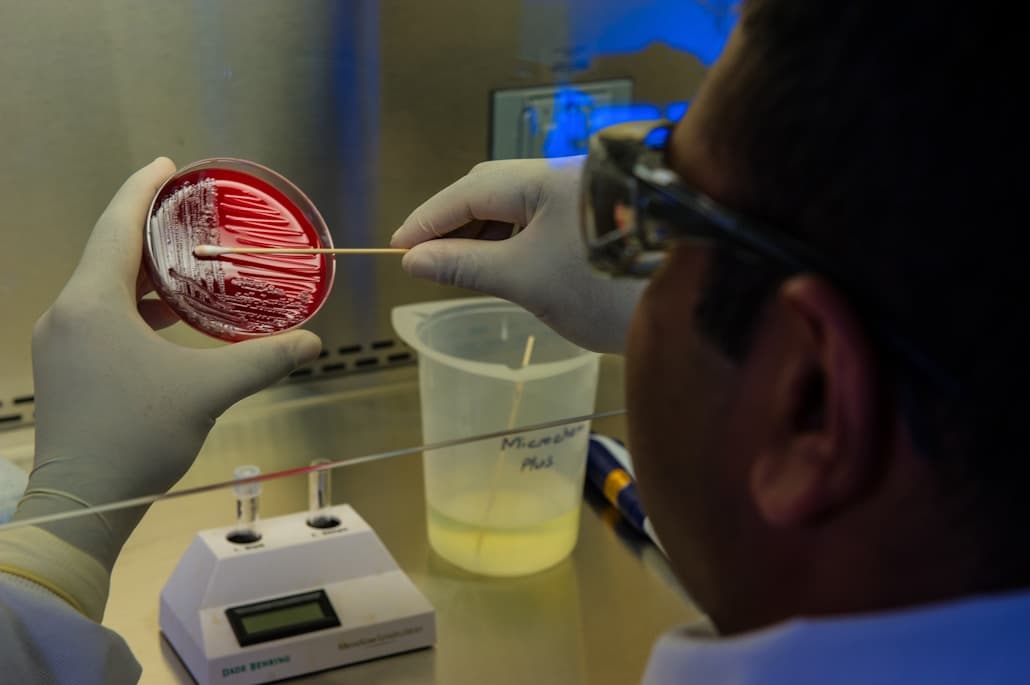
A small plastic cassette, a battery-powered pump and ten quiet minutes in your living room: that is what most people see when a mold assessor takes an air sample. What happens inside that cassette, and what the laboratory does with it afterward, determines whether the report that follows is meaningful. Here is how spore trap sampling actually works, from pump calibration to the final count.
Spore trap sampling in one paragraph
A spore trap is an air sampling cassette that draws a measured volume of air through a narrow slit and onto a sticky glass slide. Airborne particles, including mold spores, hyphal fragments, pollen, skin cells and fibers, impact the slide and stay there. The lab stains the slide and examines it under a microscope, identifying and counting spores by type. Dividing the count by the air volume sampled gives a concentration in spores per cubic meter, which is compared to an outdoor sample collected the same day.
The equipment
The cassette
The cassette is a sealed, single-use unit. Inside is a slide coated with an adhesive and a precisely sized inlet slit. When air is pulled through, it accelerates through the slit and particles are flung onto the adhesive by inertia while the air turns and exits. The cassette is opened only in the laboratory.
The pump
The pump is the part that turns a cassette into a quantitative sample. It must pull air at a known, steady flow rate, commonly fifteen liters per minute for many residential cassettes. Assessors calibrate the pump against a flow meter before sampling, record the flow rate and run time, and from those compute the total volume. Without that step the lab count cannot be converted to a concentration.
The stand
Samples are taken at roughly breathing height, often three to five feet off the floor, on a tripod or stand placed away from walls and direct airflow. Holding a cassette by hand near a supply register would skew everything.
What gets sampled and where
A standard sampling plan in a comprehensive mold assessment includes:
- The complaint or suspect area. The room with visible growth, odor, water history or symptoms.
- A control area. A room in the same home with no known problem, to show what "normal" looks like in that building.
- The outdoor control. Collected the same day, usually on the side of the home facing the prevailing breeze, away from vegetation and soil disturbance.
- Additional rooms as needed. Adjacent spaces, the air handler closet, or rooms sharing a wall with the suspect area.
In some investigations the assessor also collects a wall cavity sample by inserting a tube through a small opening and sampling the air inside the wall. This can confirm hidden growth that the room air sample misses.
What happens at the lab
The sealed cassette travels under chain of custody to an independent accredited laboratory. There, an analyst:
- Opens the cassette and removes the slide.
- Applies a stain that makes fungal structures easier to see.
- Examines the trace, the strip of deposited particles, under a microscope at high magnification.
- Identifies spores by shape, size, color and surface features, grouping them by genus or spore type.
- Counts spores across a defined portion of the trace and extrapolates to the whole.
- Divides by the sampled air volume to report spores per cubic meter.
- Notes the debris rating, hyphal fragments, pollen and other background particles.
Because identification is by morphology (what the spore looks like), some common genera such as Aspergillus and Penicillium cannot be told apart on a spore trap slide and are reported together. That is a known limitation of the method, not a lab error.
What the results look like
A spore trap report lists each spore type found, the raw count, and the calculated concentration for each sample. A simplified example:
| Spore type | Outdoor | Living room | Master closet |
|---|---|---|---|
| Cladosporium | Present | Lower | Lower |
| Aspergillus/Penicillium | Low | Low | Markedly elevated |
| Chaetomium | None | None | Present |
| Stachybotrys | None | None | None |
The living room mirrors the outdoors at lower levels, which is what a healthy indoor space looks like. The closet shows a spore type that is barely present outdoors at much higher concentration, plus a water-indicator genus the outdoors did not contribute. That pattern, combined with moisture readings and visual findings, is what points to an indoor source.
Strengths of the spore trap method
- Captures both viable and non-viable spores, which matters for allergy and irritation.
- Fast turnaround compared with culture-based methods.
- Quantitative, allowing before-and-after comparison for post-remediation verification.
- Widely accepted by remediators, insurers and attorneys in Florida.
Limitations you should know
- It is a snapshot. Conditions during the run determine the result.
- Identification is limited. Some genera are grouped, and species cannot be determined.
- Overloading. In dusty environments the slide can become too crowded to count accurately, so the assessor shortens the run.
- No health threshold. There is no universally accepted spore concentration that defines "safe." Interpretation is comparative.
- Hidden growth can hide. Sealed cavities may contribute little to room air until disturbed.
These limitations are why spore traps are interpreted together with moisture mapping, thermal imaging and surface samples rather than in isolation.
Florida factors that affect spore trap results
Central Florida's outdoor air carries heavy spore loads most of the year, dominated by Cladosporium and various basidiospores and ascospores from vegetation. Indoor samples in a well-functioning home should show a similar profile at lower levels. Air conditioning that runs most of the year filters some outdoor spores but can also spread indoor sources quickly. After an afternoon thunderstorm, outdoor counts often shift as rain washes some spores out and splashes others up. Assessors record weather conditions for this reason, and the same-day outdoor control remains the only valid comparison.
Sampling at post-remediation verification
Spore traps are the backbone of PRV. After the remediator finishes and before containment comes down, the assessor samples inside the work area and outdoors again. The protocol written at the start defines what counts as passing. Because UES never performs remediation, the clearance samples are collected and interpreted by someone with no stake in whether the job passes.
All results, including the raw lab data and the assessor's interpretation, are posted in the UES Client Portal so you and your remediator see the same numbers.
Preparing your home for air sampling
To get representative results, assessors usually ask you to:
- Keep windows and doors closed for a day before the visit.
- Run the HVAC system as you normally would.
- Avoid vacuuming, dusting or running fans right before the appointment.
- Leave suspect areas undisturbed. Do not clean or spray the mold.
These steps keep the sample reflective of the air you actually live in.
When to call UES
A spore trap sample is only as good as the plan behind it and the independence of the person interpreting it. UES designs each sampling plan around your home's moisture findings and sends every cassette to an independent accredited lab. We serve Orlando, Lake County, The Villages, Tampa and all of Florida. Book an assessment online or call (407) 438-4684, Monday through Friday, 9:00 AM to 5:30 PM. For questions about the process, see our FAQ.
Related reading
Frequently asked questions
How long does a spore trap sample take?
Each sample typically runs five to ten minutes, depending on the cassette and the expected particle load. Dusty or heavily contaminated areas may call for a shorter run so the slide does not become overloaded. A full assessment with several indoor samples plus an outdoor control usually adds up to under an hour of pump time.
Why do spore trap results vary from one day to the next?
A spore trap captures a brief window of air. Spore release changes with humidity, temperature, HVAC cycling, foot traffic and weather, so two samples from the same room on different days will not match exactly. That is normal, and it is why assessors interpret results against a same-day outdoor control and alongside moisture findings rather than treating any number as absolute.
Does a low spore count mean my home has no mold?
Not necessarily. Growth sealed inside a wall cavity or beneath flooring may release few spores into the room air at the moment of sampling. A low count in a room with elevated moisture readings and a persistent odor is a reason for further investigation, not reassurance.
Worried about what you just read?
An independent UES assessment tells you exactly what is going on, what caused it and what to do next. Book online or call.

