Buying an air purifier before testing your air is guessing. Learn what purifiers can and cannot remove and why Florida homes should test first.
A persistent sneeze, a vague musty note, a child who coughs at night: the instinctive response is to order an air purifier and hope. Sometimes it helps. Often it hums in the corner while the actual problem, a damp closet, a sweating air handler or a particleboard bookcase off-gassing formaldehyde, continues untouched. The order of operations matters. Measure first, then decide whether a purifier is even the right tool.
What air purifiers actually do
Most residential air purifiers are fans that push room air through a filter. What the filter captures depends entirely on its type, and the physics of each is different.
Mechanical particle filters (HEPA)
A HEPA filter is a dense mat of fibers. Particles are captured through three mechanisms that depend on size:
- Large particles (several micrometers and up) are too heavy to follow the air stream around fibers and crash into them, a process called impaction.
- Mid-size particles follow the stream but pass close enough to a fiber to touch it, called interception.
- Very small particles (well under a micrometer) are jostled by air molecules in random Brownian motion, which makes them wander into fibers, called diffusion.
The hardest particles to catch sit in the middle, around 0.3 micrometers, where none of the three mechanisms dominates. That is why HEPA efficiency is specified at that size. True HEPA filters capture most particles across the size range, including mold spores, pollen, dust mite waste and much fine particulate. What they cannot capture is anything that is not a particle.
Activated carbon
Carbon filters work by adsorption: gas molecules stick to the enormous internal surface area of porous carbon. They can reduce some VOCs and odors. The limitations are capacity and specificity. A thin carbon pre-filter in a consumer unit saturates quickly, and carbon captures some compounds far better than others. Formaldehyde, for example, is poorly adsorbed by plain carbon unless the media is specially treated.
Electronic and ionizing technologies
Ionizers charge particles so they stick to surfaces or collector plates. Some produce ozone as a byproduct, which is a respiratory irritant. Ozone generators marketed as purifiers deliberately produce ozone and should not be run in occupied spaces. UV lamps can inactivate some microorganisms given enough exposure time, but air moves past a lamp in a fraction of a second, which limits effectiveness in a portable unit.
What purifiers cannot do
| Problem | Can a purifier fix it? | What actually fixes it |
|---|---|---|
| Active mold growth | No | Moisture correction and remediation |
| High humidity | No | AC operation, envelope sealing, dehumidification |
| Musty odor from hidden mold | Not meaningfully | Locating and removing the source |
| VOCs from furniture or renovation | Partially, with substantial carbon | Source removal and ventilation |
| Carbon monoxide | No | Eliminating the combustion source; alarms |
| Dust mite allergen in bedding | No | Encasements, hot washing, humidity below 50 percent |
| Airborne spores and dust in one room | Yes, within that room | Purifier is appropriate here |
| Wildfire or outdoor smoke infiltration | Yes, for the particulate fraction | Purifier plus sealing and HVAC filtration |
The pattern is clear. Purifiers address airborne particles in the room where they sit. Most indoor air quality complaints in Florida trace back to moisture, which is not a particle, or to a source that keeps generating contaminant faster than a filter can remove it.
Why testing first saves money and frustration
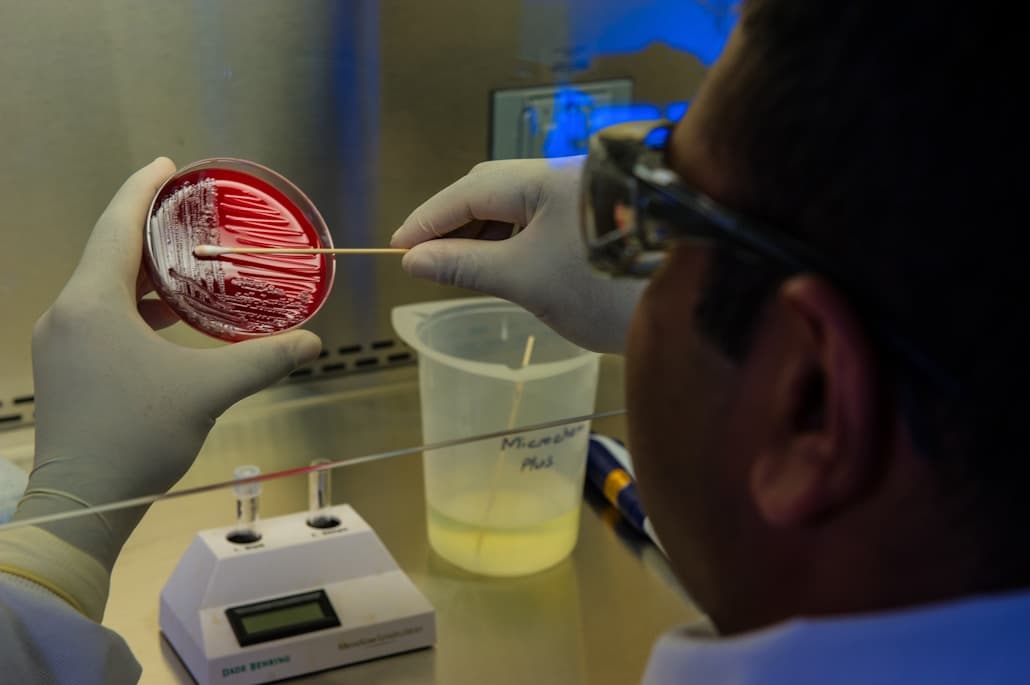
Testing answers the question a purifier cannot: what is in the air, and where is it coming from? A UES indoor air quality and allergen testing visit measures humidity and temperature room by room, counts particles in several size ranges, screens for VOCs and carbon monoxide, and collects spore-trap air samples plus an outdoor comparison sample for analysis by an independent accredited laboratory under chain of custody. Where moisture is suspected, thermal imaging and moisture meters locate it.
The results sort your situation into one of a few categories:
- A moisture and mold problem. Indoor spore levels or types exceed outdoors, and wet materials are found. A purifier is a distraction; a written protocol and remediation are needed. See our comprehensive mold assessment.
- A chemical source. VOC screening points to a room or an item. Removing or isolating the source and ventilating is the fix; carbon filtration is at most a supplement.
- A humidity problem. Readings run above 60 percent. The fix is HVAC operation, sealing or a dehumidifier.
- A particulate problem without a moisture cause. Cooking, outdoor smoke, pets or renovation dust dominate. This is where a correctly sized HEPA purifier, better HVAC filtration and source habits genuinely help.
- Nothing elevated. Indoor conditions match outdoors. That tells you and your physician to look elsewhere for the cause of symptoms, and it saves you from buying equipment you do not need.
Because UES does not sell purifiers, filters, dehumidifiers or remediation, the assessment has no stake in which category you land in. Findings are delivered in the UES Client Portal as measured.
If a purifier is the right answer
When testing shows a particulate problem that filtration can address, a few principles make the purchase effective.
- Match the unit to the room. Manufacturers rate units by room size or by clean air delivery rate. Undersized units cycle the air too slowly to matter.
- Choose true HEPA. Terms like "HEPA-type" or "HEPA-like" do not meet the standard.
- Place it where the exposure is. Usually the bedroom, running continuously at a setting you can sleep with.
- Skip ozone. Avoid any unit that produces ozone intentionally or as a byproduct.
- Maintain it. A clogged filter moves little air. Replace on schedule.
- Pair it with HVAC filtration. Whole-house filtration through the air handler reaches every room; see our guide to HVAC filters and MERV ratings.
- Retest. A follow-up particle count confirms the unit is doing its job.
The Florida-specific caution
In this climate, the most common reason for a purifier purchase is a musty smell or an allergy flare, and the most common underlying cause of both is moisture. A purifier in a room with 65 percent humidity and a sweating supply register is treating the symptom while the disease progresses behind the drywall. If you remember one thing from this post, let it be that mustiness and humidity are moisture problems first, and moisture problems require measurement, not filtration.
When to call UES
Call before buying equipment if you have allergy or respiratory symptoms at home, a musty odor, high humidity readings or a recent water event. Call after buying if a purifier has not helped and you want to know why. Book an assessment online or call (407) 438-4684, Monday through Friday, 9:00 AM to 5:30 PM. Our FAQ explains which service fits different situations.
Related reading
Frequently asked questions
Will an air purifier get rid of mold?
No. A HEPA purifier can capture airborne spores passing through it, which may reduce exposure in that room, but it does nothing about the colony producing them or the moisture feeding it. Mold on a wall, in a closet or in the air handler keeps releasing spores faster than a purifier can remove them. Fixing the moisture and removing the growth is the only durable solution.
Do air purifiers remove humidity or odors?
Particle filters do not remove humidity, and most do not remove gases. Odors and VOCs are gases, so they pass straight through a HEPA filter. Units with substantial activated carbon can adsorb some gases for a time, but the carbon saturates and must be replaced. A dehumidifier addresses humidity; source removal addresses odors.
Is it worth testing before buying a purifier?
Usually, yes. Testing identifies whether your problem is particles, gases, humidity, mold or a combination, and in which rooms. That tells you whether a purifier would help at all, what type and size you need, and where to place it. Many people who test discover the real issue is moisture or a source that no purifier would address.
Worried about what you just read?
An independent UES assessment tells you exactly what is going on, what caused it and what to do next. Book online or call.