ERMI dust testing, spore trap air sampling and surface testing answer different questions. Learn what each mold test measures and which fits a Florida home.
A musty smell in a Winter Park bungalow, a dark stain under a Kissimmee kitchen sink and a family in The Villages who feel better the moment they leave the house are three different problems. Each calls for a different test. Choosing the wrong one produces a clean report that proves nothing, or a frightening report that means less than it seems.
This guide compares the three most common mold testing methods in Florida homes, ERMI dust analysis, spore trap air sampling and surface sampling, by what each one measures, how the laboratory processes it, where it shines and where it misleads.
The direct answer
Air sampling measures what is airborne at the moment of collection and is best for locating an active source and for post-remediation clearance. Surface sampling confirms whether a visible stain is mold and identifies the genus. ERMI and HERTSMI dust testing use DNA analysis of settled dust to estimate which species have accumulated in the home over time, which is most useful when symptoms persist and air samples do not explain them. No single method is the "best" mold test; the right one depends on the question being asked.
How each method works
Spore trap air sampling
A calibrated pump draws a known volume of air through a cassette for a set number of minutes. Airborne particles, including mold spores, pollen, skin cells and fibers, strike a sticky slide inside. At the lab, an analyst examines the slide under a microscope, counts the spores by type and converts the count to spores per cubic meter of air.
Because the result is a snapshot, an outdoor control sample taken the same day is essential. Florida's outdoor air carries high spore loads year-round, so an indoor count only means something when compared with the outdoor baseline and with other rooms. Our post on spore trap sampling covers the mechanics in more depth.
Surface sampling
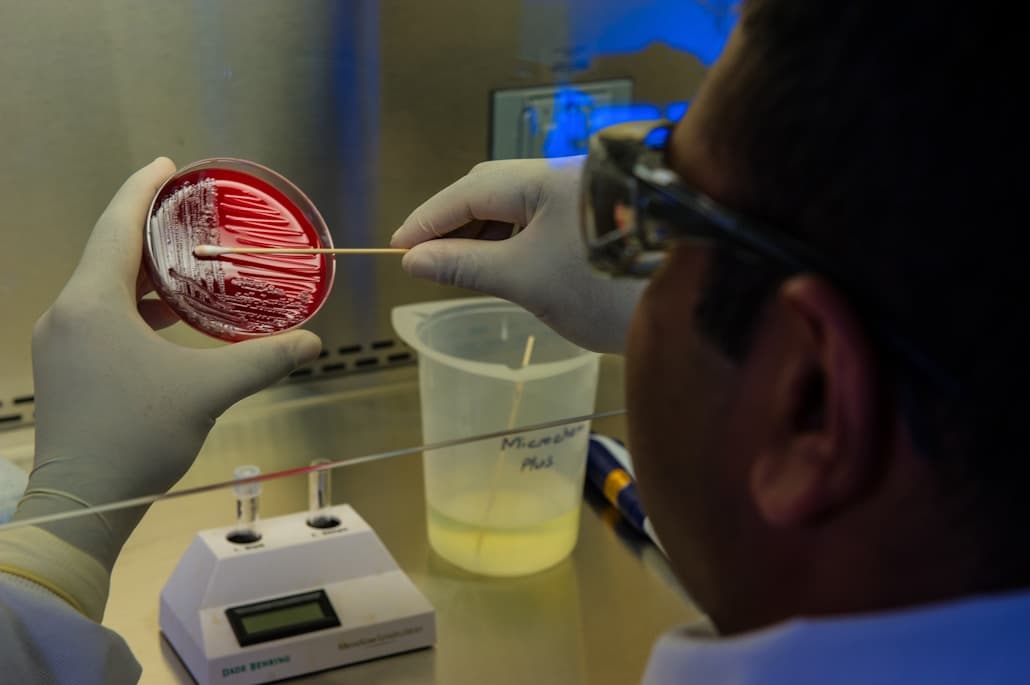
A tape lift presses clear adhesive against a stain and transfers whatever is there to a slide. A swab collects material from an irregular surface. A bulk sample is a small piece of the material itself. The lab examines the sample microscopically and reports whether mold structures are present, which genera, and sometimes whether the growth appears active (with hyphae and spore-producing structures) or is settled spores on an otherwise clean surface.
Surface sampling answers a yes-or-no question about a specific spot. It says nothing about the air you breathe and nothing about rooms you did not sample.
ERMI and HERTSMI dust testing
ERMI (Environmental Relative Moldiness Index) and its shorter cousin HERTSMI-2 analyze a composite dust sample, typically collected by vacuum from carpet or by cloth wipe from surfaces, using a DNA method that identifies and quantifies dozens of specific mold species. The result is not a spore count. It is a species profile weighted into an index score that reflects which water-damage-associated species are present relative to common outdoor species.
Because dust accumulates over weeks and months, the sample reflects history rather than a moment. The method was developed as a research tool, and its interpretation for individual homes is debated, so a careful assessor treats the score as one line of evidence rather than a verdict. Learn more about how we use it on our ERMI and HERTSMI dust testing page.
Side-by-side comparison
| Spore trap air sample | Surface sample | ERMI / HERTSMI dust | |
|---|---|---|---|
| What it measures | Airborne spores during collection | Growth on a specific surface | Species DNA in accumulated dust |
| Time window | Minutes | Current state of the surface | Weeks to months |
| Lab method | Microscopy, spore counting | Microscopy | DNA analysis |
| Identifies to | Genus or spore type | Genus, sometimes activity | Species |
| Needs outdoor control | Yes | No | No |
| Best for | Locating sources, clearance testing | Confirming a stain is mold | Persistent symptoms, history |
| Weakness | Snapshot; misses enclosed growth | Only the spot sampled | Does not locate the source |
Where each method shines
Air sampling shines when there is a musty odor with no visible growth, when occupants react in one room but not another, when you need to know whether growth inside a wall is reaching the living space, and at post-remediation verification, where it is the standard tool for comparing the finished work to clearance criteria.
Surface sampling shines when you have a visible stain and need to know whether it is mold, mildew, dirt, soot or efflorescence; when you need to document a specific condition for an insurer, buyer or landlord; and when a bulk sample of removed drywall or insulation will settle whether a material is colonized.
ERMI dust testing shines when someone in the home has ongoing symptoms, air samples have come back unremarkable, and you want a longer view of what has accumulated. It is also used by some physicians as part of a broader picture. We recommend speaking with your doctor about symptoms; the test informs the building side of the conversation.
Where each method misleads
Every method has a failure mode, and most bad mold reports come from ignoring it.
- Air samples miss enclosed growth. Mold behind an intact wall or inside a sealed cabinet may release few spores into the room. A clean air sample does not mean a clean wall. This is why moisture meters and thermal imaging are not optional.
- Air samples vary by the hour. Running the air handler, opening a door or vacuuming before the visit changes the count. A single sample on a single day is a data point, not a trend.
- Surface samples prove only the spot. A tape lift from one corner says nothing about the closet next door.
- ERMI scores do not point to a location. A high score tells you water-damage species have accumulated somewhere. It does not tell you which wall. It also reflects dust that may have arrived with furniture or from a previous home.
- ERMI is sensitive to how the dust was collected. Carpet versus hard floor, vacuum versus cloth, new construction versus occupied for twenty years. Comparing one home's score to another's is less meaningful than it appears.
Chemistry: the tests that are not mold tests
Not every "mold smell" is mold. The musty odor people describe is often microbial volatile organic compounds, or MVOCs, the gases produced by actively growing fungi and bacteria. Other odors trace to formaldehyde from new cabinetry, VOCs from flooring adhesives or paint, or combustion byproducts. When the complaint is odor or irritation rather than visible growth, VOC and formaldehyde testing may answer the question that spore counts cannot. Mycotoxin testing is another specialized method, measuring fungal toxins in dust or materials rather than spores or DNA.
How a licensed assessor chooses
A good assessment does not start with a test. It starts with a forensic visual inspection, moisture readings and a conversation about what you are experiencing and where. The test is chosen to answer the question that inspection raises:
- Visible stain, unknown cause: surface sample.
- Odor or symptoms, no visible growth: moisture diagnostics first, then air samples in the suspect rooms with an outdoor control.
- Air samples unremarkable, symptoms persist: consider ERMI or HERTSMI dust analysis and chemical testing.
- Remediation complete: air samples against the clearance criteria in the protocol, plus visual and moisture verification.
Because UES does not remediate and accepts no referral fees, we have no reason to recommend a method that produces a scarier number. We recommend the one that answers your question, and we explain what the result does and does not mean in the UES Client Portal.
When to call UES
If you are weighing which mold test makes sense for your home in Orlando, Leesburg, The Villages or anywhere in Florida, our comprehensive mold assessment begins with the inspection and lets the findings drive the sampling. Book an assessment online or call (407) 438-4684, Monday through Friday, 9:00 AM to 5:30 PM. We assess, test and diagnose, and we never remediate.
Related reading
Frequently asked questions
Is ERMI testing better than air sampling for mold?
Neither is better; they measure different things. ERMI analyzes settled dust by DNA to estimate the history of mold species in a home over months, while a spore trap air sample measures what is airborne during a few minutes of collection. Air sampling is better for locating an active source and for clearance testing. ERMI is useful when symptoms persist and air samples look unremarkable.
Can a surface test tell me if mold is dangerous?
A surface sample identifies the genus of mold on a stain and confirms whether growth is present rather than dirt or soot. It does not measure exposure, and no test can diagnose a health effect. If you or your family have symptoms, speak with a physician, and use the test results to understand and fix the building conditions.
Do I need all three tests in my Florida home?
Most homes do not. A licensed assessor chooses the method based on the question. Visible staining usually calls for surface sampling; a musty smell with no visible growth often calls for air sampling plus moisture diagnostics; persistent unexplained symptoms may justify ERMI dust analysis. Combining methods makes sense when one method raises a question another can answer.
Worried about what you just read?
An independent UES assessment tells you exactly what is going on, what caused it and what to do next. Book online or call.